🐔 Chicken Train – Run the Tracks and Play for Real
Chicken Train is a fast, timing-based real-money arcade game built for players who enjoy pressure, decision-making, and risk. Every round lasts seconds, but the decisions inside those seconds feel significant. A single tap can secure a win – or end the run instantly. That structure turns every attempt into a focused moment where instinct and discipline collide.
There’s no warm-up mode, no slow build, no passive watching. You start, the multiplier begins climbing, the tracks come alive, and the question arrives faster than you expect:
“Stop now… or go further?”
That moment defines the entire experience – and it repeats over and over because each run feels like an opportunity to do better than the last.
🚂 What Is Chicken Train?
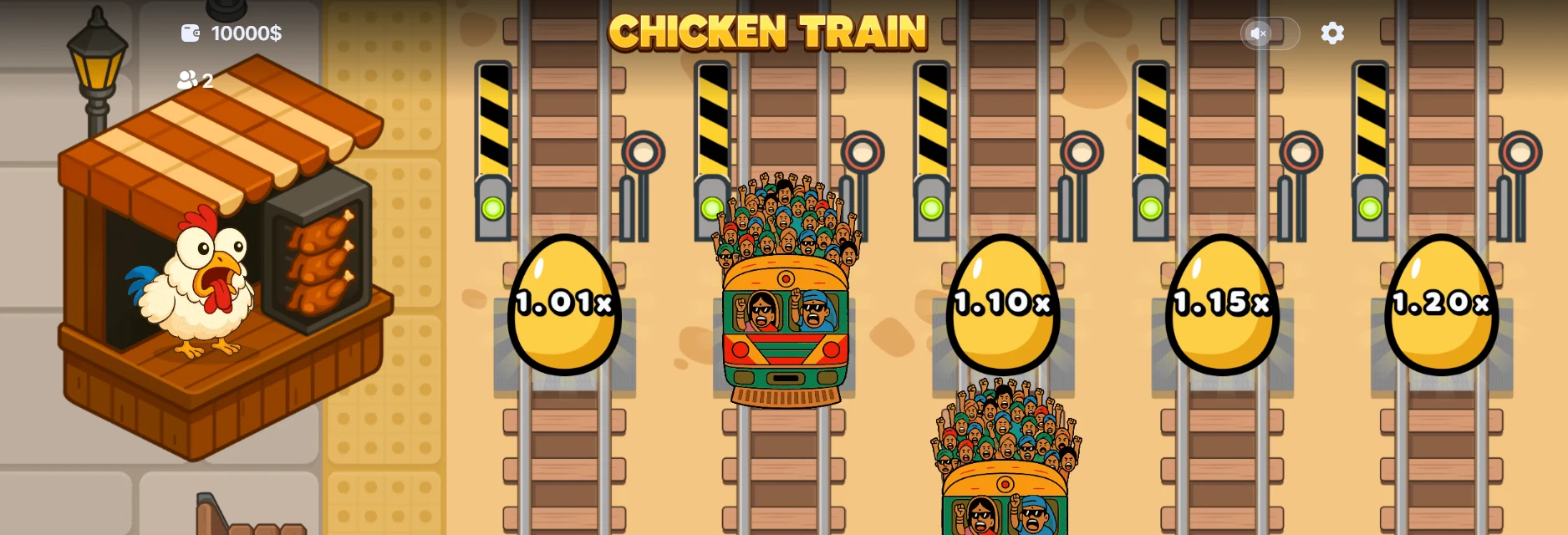
Chicken Train is a real-money arcade survival game where timing determines outcome. Players place a wager, start a run, and watch the multiplier scale upward as they survive trains rushing across multiple tracks. The goal: reach the right moment to cash out before risk peaks.
The rules are simple, but execution is not – reaction, pattern recognition, and emotional control all affect performance.
🎮 The Core Idea
Chicken Train merges fast reflex gameplay with structured wagering:
- Real stakes and real outcomes
- Instant round start – no delays
- Multipliers grow the longer you survive
- Cash out at any time – if you dare
- One mistake ends the round
- Restart is instant
The design ensures every run feels like a compact decision loop, not a waiting game.

🎧 The Vibe and Atmosphere
This game isn’t abstract or sterile – it feels grounded in real-world rhythm. The environment draws from the energy of South Asian railways: unpredictable train schedules, layered sound, and constant motion. That sense of realism makes the timing feel natural instead of artificial.
🕹 How to Play Chicken Train
Learning the rules takes seconds. Mastering them takes much longer.
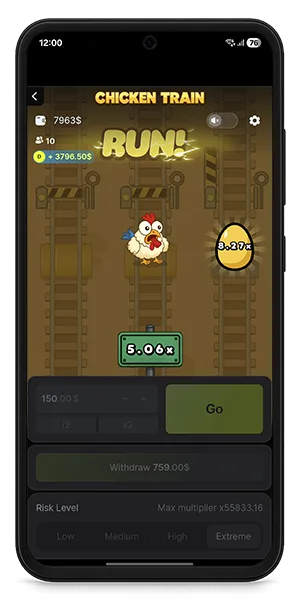
Tap to move forward. Watch the trains. Wait for safe timing. Cash out before danger peaks.
Controls
- Tap/Click → Move forward one space
- Cash Out → End run and claim payout
- Restart → Immediately begin another attempt
No combos. No complexity. Just decision + timing.
Timing and Movement
Unlike passive gambling formats, Chicken Train requires reaction and judgment. Tracks alternate between predictable rhythm and sudden spikes, especially at higher risk levels. Players must balance:
- Patience
- Reaction speed
- Predictive reading
Moving too early or too late results in the same outcome – elimination.
Common Beginner Mistakes
New players often fall into predictable patterns:
- Moving constantly instead of waiting
- Chasing multipliers without a plan
- Switching to high risk too early
- Treating a loss as something to “correct” immediately
- Forgetting that not moving is sometimes the correct move
Most of these behaviors are emotional, not logical – and reducing emotional impulse is a key turning point in player evolution.
🔥 Why Chicken Train Becomes Addictive
The gameplay loop is short, intense, and rewarding. Each round ends with a definitive result – no ambiguity. That clarity is powerful: you either made a correct decision or you didn’t.
The “One More Run” Loop
Because outcomes are tied to timing and skill, players rarely walk away after a loss. Instead, they think:
“I know exactly what I should’ve done.”
That mindset drives replay.
| Moment | Internal Dialogue |
| First safe win | “Easy – I can go further next time.” |
| First big fail | “Too greedy. I’ll adjust.” |
| First extreme-risk win | “That felt unreal.” |
| After multiple small wins | “Now I can take a bigger shot.” |
| After any mistake | “Restart.” |
The cycle isn’t powered by randomness – it’s powered by self-correction.
The Skill Curve
Over time, decision quality improves:
- Hesitation decreases
- Emotional cash-outs become intentional ones
- Players start setting stopping conditions
- Pattern recognition emerges naturally
- Self-control becomes part of strategy
The game evolves from “reaction” to execution under pressure.
The Chaos Factor
Chicken Train intentionally blends predictability with volatility. Some sequences feel readable; others feel like controlled chaos. This prevents routine play and ensures each run requires attention.
📈 Progression and Rewards
Chicken Train rewards well-paced decision-making rather than blind risk.
Score System
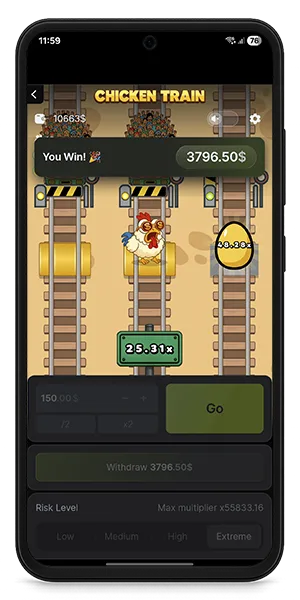
The final result is determined by:
- Wager size
- Time survived
- Selected risk level
- Moment of exit (cash-out timing)
Higher difficulty accelerates both potential gain and emotional pressure.
Unlockable Features
Progress is reinforced with unlockables such as:
- New visual themes
- Sound variations
- Route variations
- Seasonal cosmetic packs
- Achievement medals
These don’t guarantee better performance – they reward consistency.
Achievement Milestones
A few examples:
- First multiplier above x10
- First extreme-level survival
- Surviving without hesitation inputs
- Achieving three consistent runs in a row
Milestones create structure and goal-based play rather than emotional play.
🎚 Risk Levels
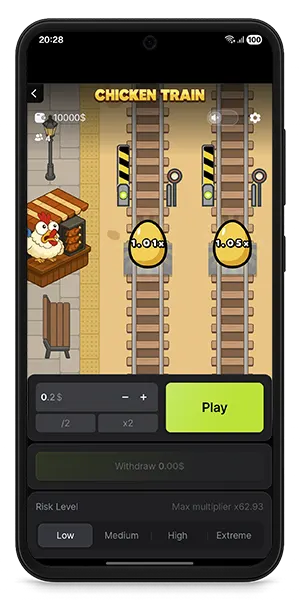
The core mechanical depth comes from the four selectable risk tiers. Each level changes pacing, reward potential, and cognitive load.
| Risk Level | Minimum Multiplier | Maximum Multiplier | Player Type |
| Low | 1.01× | 62.93× | Safe runs, low volatility, disciplined bankroll management |
| Medium | 1.04× | 267.56× | Balanced risk and reward – ideal for steady play sessions |
| High | 1.15× | 10,308.99× | Aggressive pacing – rewards bold, calculated timing |
| Extreme | 1.40× | 55,833.16× | Maximum volatility – results swing dramatically |
Choosing a risk level isn’t just selecting a number – it defines your psychological profile for the round.
Low risk requires patience.
High risk requires emotional neutrality.
Extreme risk requires accepting volatility before starting.
🧠 The Psychology of Timing and Real Stakes
Real-money gameplay activates a different mental framework compared to demo or free games. Players experience:
- Elevated focus
- Faster pattern recognition
- Heightened emotional memory
- Stronger decision anchoring
In psychology terms, Chicken Train operates at the intersection of:
- Reactive processing (System 1)
- Reflective decision-making (System 2)
The game constantly forces players to choose between instinct and logic.
Players who succeed long-term typically:
- Set multipliers before the round, not during
- Treat streaks as neutral, not “lucky”
- Limit play sessions intentionally
- Track results by behavior, not emotion
Over time, players develop a personal playing identity – cautious, controlled, aggressive, or adaptive.
🎯 Strategy – How to Get Better
Improvement isn’t random – it follows predictable stages.
Stage 1 – Learn the Rhythm
You begin recognizing train timing patterns and micro delays. Mistakes feel sharper, not confusing.
Stage 2 – Emotional Regulation
Players start cashing out earlier – not from fear, but from control.
Stage 3 – Pattern Integration
Reaction becomes anticipation. Movement becomes timing rather than luck.
Stage 4 – Risk Mastery
You intentionally choose when to push beyond rational safety.
Stage 5 – Meta-Strategy
You no longer evaluate single runs – you evaluate sessions.
Warm-Up Runs
Most skilled players start with:
- 1–2 low-risk rhythm calibration runs
- One medium-risk diagnostic run
- Then session-level wagering
Warm-ups reduce impulsive decisions and increase consistency.
Advanced Techniques
As experience grows, players start using:
- Pre-defined cash-out thresholds
- Pattern clustering (recognizing recurring behavioral rhythm)
- Intensity mapping (recognizing risk spikes)
- Loss isolation (not letting the previous run influence the next)
These strategies are subtle – but they create measurable improvement.
🌍 Built for South Asian Players
The game’s experience reflects the railway culture across India, Bangladesh, Pakistan, and Nepal: movement, rhythm, unpredictability, and familiarity.
Sound and Ambience
Players will recognize sound patterns similar to:
- Local train horns
- Station signal rhythms
- Track noise
- Background chatter
These aren’t random – they’re intentional cues.
Visual Style and Setting
The design combines:
- Familiar station architecture
- Track layout logic
- Realistic color psychology
- Local cultural rhythm
The environment feels authentic rather than artificial.
📱 Where You Can Play Chicken Train
The game supports multiple platforms and is intentionally optimized for smooth performance.
Supported Platforms
- Android
- iOS
- Browser
- Tablet devices
Device Performance
Chicken Train is lightweight – no heavy downloads, no long installs. It is optimized for:
- Fast loading
- Low resource strain
- Smooth frame pacing
- Reliable performance even on older models
Players stay focused on gameplay – not waiting screens.

🚀 Upcoming Features and Roadmap
The game will continue evolving based on real player behavior.
Planned additions include:
- Global leaderboards
- Regional ranking tiers
- Friend challenges
- Seasonal reward cycles
- Extended multiplier events
- Unlockable experience tracks
Updates will enhance competitive structure without complicating gameplay.
❓ FAQ
Is Chicken Train a real-money game?
Yes – wagers apply to multiplier outcomes based on survival.
Can I switch risk levels before each run?
Yes – risk selection happens before the round starts.
How long does an average round last?
Most rounds last seconds – which keeps gameplay fast and repeatable.
Is the game based on luck?
Performance improves with timing, pattern recognition, and discipline – not random outcome.
Will there be leaderboards?
Yes – ranked play is part of the planned competitive roadmap.
Do I need an account to play?
Platform rules vary – usually accounts are required for balance management and withdrawals.