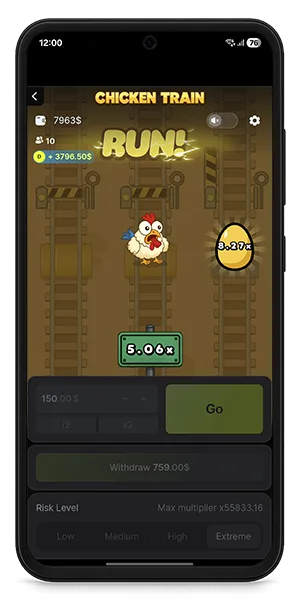
🐔 Chicken Train Demo – Practice Timing Before Playing for Real
The demo version of Chicken Train lets you experience the full gameplay loop without risk. It works exactly like the real-money version: same mechanics, same timing patterns, same risk levels, same survival logic. The only difference is the outcome – your results in demo mode aren’t tied to wagers or withdrawals.
The demo exists for one purpose: to build confidence and precision before stepping into real stakes.
For many players, it becomes an essential warm-up tool. For others, it’s a safe environment to understand mechanics, rhythm, and emotional control before playing with real values.
🎯 What the Demo Includes
The demo isn’t a simplified or limited version – it mirrors the full structure of the real game. That means you get:
- Full access to timing-based survival gameplay
- All four risk levels
- Identical multiplier behavior
- Real pacing and difficulty escalation
- Instant play and instant restart
- Practice runs without spending money
Some games change difficulty or probability between demo and real play. Chicken Train does not.
If you perform well here, the skills transfer directly.
🕹 How the Demo Works
You start a run, the multiplier begins climbing, and trains rush across the tracks. Your job is to survive long enough to reach a multiplier you consider worth locking in.
The controls remain simple:
- Tap to move forward
- Wait to avoid trains
- Cash out – when confident
- Restart instantly after each run
Demo play teaches muscle memory – not just rules.
🧠 Why Start with Demo Mode
New players often underestimate how much timing matters. One tap too early or one hesitation too long can break a run, especially on higher risk levels. The demo provides space to learn:
- Movement rhythm
- Track tempo
- High-risk pacing
- Emotional reaction to rising multipliers
Without pressure, the brain processes patterns faster.
Many players find that after 15–30 demo runs, their decisions become intentional instead of reactive. That shift is the beginning of skill-based play.
🎚 Practicing with Risk Levels
Chicken Train includes four real-money risk profiles – and all of them are available in demo. Practicing each one helps build different competencies.
| Risk Level | Training Value | Why It Matters |
| Low | Rhythm and patience | Helps remove impulsive play |
| Medium | Timing accuracy | Builds steady improvement |
| High | Emotional control | Forces quick yet measured decisions |
| Extreme | Advanced pattern reading | Tests discipline vs. greed |
Many skilled players rotate risk tiers during demo practice to simulate different emotional environments before real sessions.
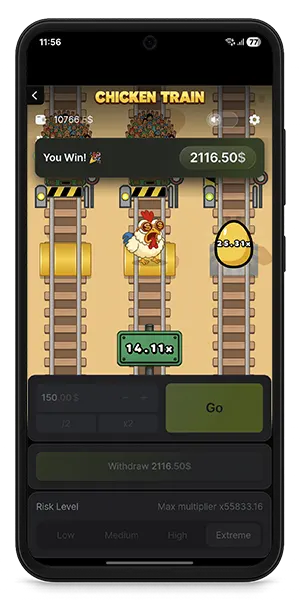
🔁 The Purpose of Warm-Up Runs
Even experienced players use demo mode before real play. Warm-ups help reset timing after a break, reduce impatience, and re-establish rhythm.
Common warm-up patterns include:
- 2 low-risk runs
- 1 medium-risk run
- Then transition to real play
The goal isn’t winning – it’s calibration.
A clear head performs better than an excited one.
📈 Using the Demo to Improve Skills
Success in Chicken Train does not rely on chance – it relies on:
- Perception
- Reaction
- Flow
- Decision timing
Demo mode allows you to isolate these skills and improve them individually.
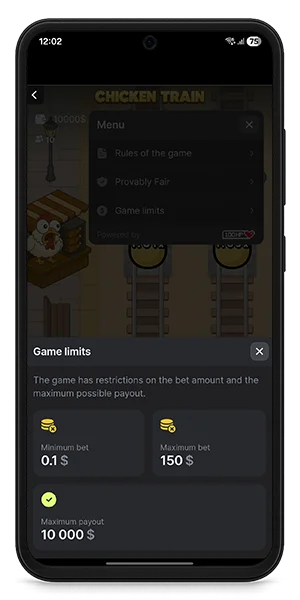
Pattern Recognition
With repeated runs, players begin noticing:
- Silent timing cues
- Micro delays
- Acceleration trends
- Risk spikes based on stage duration
This awareness dramatically improves real-money performance.
Cash-Out Discipline
The demo gives you space to practice planned exits – deciding a target before starting and sticking to it.
The biggest improvement players report is learning the difference between:
“This feels good – I’m going further.”
and
“My plan said exit here – so I exit.”
That shift creates long-term consistency.
Psychological Control
Because there’s no financial pressure in demo mode, players learn how their instinct behaves. Some play aggressively. Some hesitate. Some cash out too early.
Seeing these tendencies without consequences helps shape better strategy later.
🧩 What Changes When You Switch to Real Play
Mechanically – nothing.
Emotionally – everything.
In demo mode, your brain operates with neutrality. In real play, it introduces:
- Urgency
- Fear of missing out
- Loss aversion
- Reward anticipation
- Overconfidence after a win
This is why demo mode matters: it separates skill learning from emotional learning.
If a player jumps straight into real stakes, the emotional layer often destroys timing discipline.
Demo mode gives players a way to build a foundation first.
📱 Devices and Demo Mode Compatibility
The demo plays on the same platforms as the full version:
- Android
- iOS
- Browser
- Tablet devices
Performance, framerate, animation timing, and responsiveness remain identical.
There is no “demo lag” or simplified rendering.

🚀 When to Transition to Real Play
There’s no official rule – the transition should feel intentional, not rushed.
Most players move to real wagers when:
- They can survive multiple rounds in a row
- They reach predetermined multipliers reliably
- Wins and losses stop feeling emotional
- Their decisions follow strategy, not impulse
If the switch feels like a challenge rather than a gamble, the timing is right.
❓ FAQ
Is the demo version free?
Yes, demo play requires no deposit.
Does the demo use the same mechanics as real play?
Yes, timing, multipliers, and difficulty are identical.
Can I switch risk levels in demo mode?
Yes – all four risk tiers are available.
Does practicing in demo mode improve real-money results?
Yes, because decisions and timing skills transfer directly.
How long should I use demo mode before playing for real?
As long as needed until decisions feel controlled instead of rushed.